

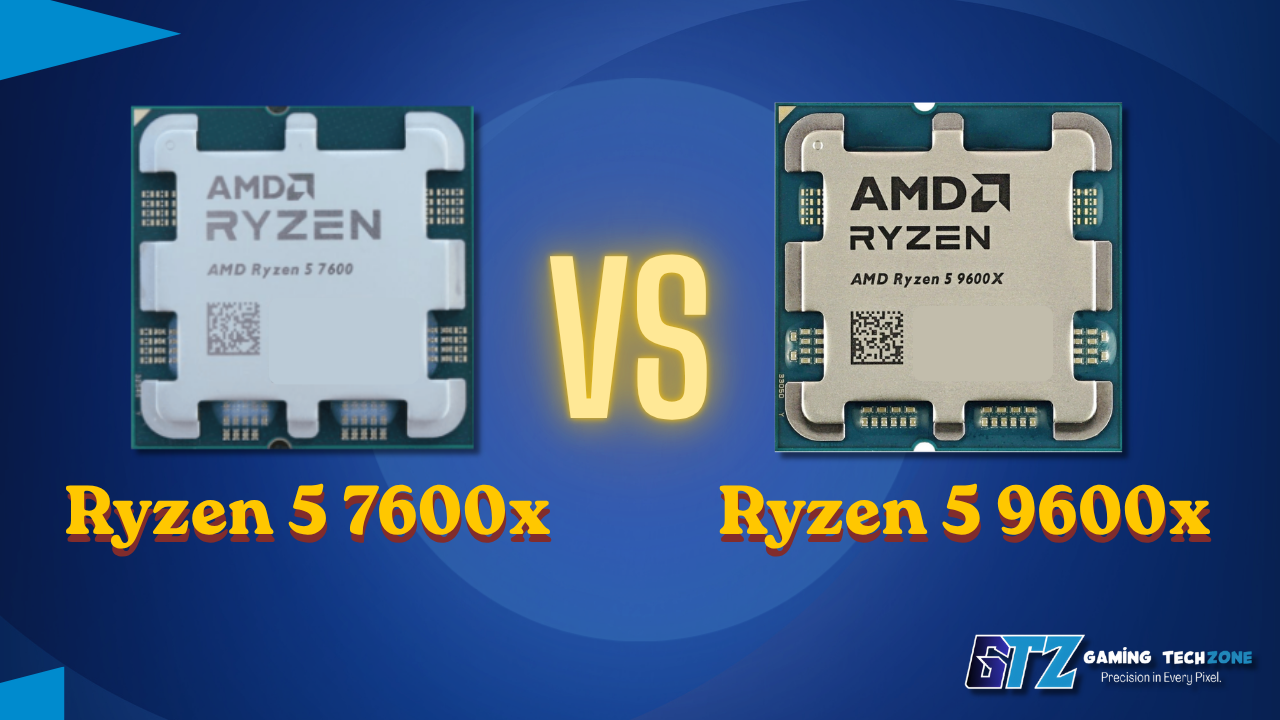
Choosing between the Ryzen 5 7600X and Ryzen 5 9600X looks straightforward on paper: both have 6 cores, 12 threads and use AMD’s AM5 platform. But with their current prices sitting so close together, the older 7600X is much harder to justify than it was when it launched.
In this comparison, I’ll look at gaming performance, productivity, power consumption, thermals and current value to show where the 9600X actually pulls ahead and where the 7600X still makes sense. By the end, you’ll know which CPU I’d buy for a new AM5 build, when the 7600X is worth considering, and whether upgrading from a 7600X is worth your money.
Quick Verdict
Already decided? Here’s the bottom line:
What is the Difference Between Ryzen 5 7600X vs 9600X?
| Spec | Ryzen 5 7600X | Ryzen 5 9600X |
|---|---|---|
| Architecture | Zen 4 (Raphael) | Zen 5 (Granite Ridge) ✓ |
| Process Node | 5nm TSMC | 4nm TSMC ✓ |
| Cores / Threads | 6 / 12 | 6 / 12 |
| Base Clock | 4.7 GHz ✓ | 3.9 GHz |
| Boost Clock | 5.3 GHz | 5.4 GHz ✓ |
| TDP | 105W | 65W ✓ |
| L3 Cache | 32 MB | 32 MB |
| Memory Bandwidth | 83 GB/s | 90 GB/s ✓ |
| PCIe Version | 5.0 | 5.0 |
| Socket | AM5 | AM5 |
| Launch MSRP | $299 | $279 ✓ |
| Current Street Price | ~$185–$200 | ~$185–$210 |
What is the Performance Difference Between Ryzen 5 7600X and 9600X?
The 9600X leads in single-thread speed and productivity work, but its gaming advantage is small and depends heavily on the title. At 1440p and 4K, most GPU-bound games show almost no difference between the two chips.
Key numbers:
- Productivity (encoding, Photoshop, Blender): 9600X 7–10% faster
- Single-thread: 9600X ~11% faster (PassMark)
- Multi-thread: 9600X ~6% faster (PassMark)
- Gaming average: 9600X 3–6% faster at 1080p, gap disappears at 1440p/4K
- Rainbow Six Siege: 9600X up to 17% faster
- Assassin’s Creed Shadows: no meaningful difference
- Cyberpunk 2077: 7600X slightly ahead in one test pass
Who is More Power Efficient Between 7600X and 9600X?
The 9600X runs far cooler and pulls significantly less power than the 7600X at stock settings, with no downside for gamers. Unlocking its 105W BIOS mode only helps in heavily multi-threaded work, not gaming.
Key numbers:
- 9600X 105W BIOS mode: +3–5% in Cinebench, no gaming benefit
- TDP: 7600X 105 W vs 9600X 65 W
- Load temps: 7600X ~95°C vs 9600X ~56°C
- Productivity power draw: 7600X ~76 W vs 9600X ~60 W
- Gaming power draw: 7600X ~76 W vs 9600X ~66 W
The Comparison Ryzen 5 7600X vs Ryzen 5 9600X
Specs only tell part of the story, so this section puts the two chips head-to-head across raw benchmarks, real-world gaming performance, and current pricing. Together, these three angles show where the generational upgrade actually pays off and where it barely registers.
Which is Better in Benchmarks?
The 9600X’s IPC gains show up clearly in single-thread and productivity benchmarks, even though the promised 16% improvement never fully translated into gaming. Its advantage scales with how multi-threaded the workload is.
Key numbers:
- Single-thread: 9600X ~11% faster (PassMark)
- Multi-thread: 9600X ~6% faster (PassMark)
- Productivity (encoding, Photoshop, Blender): 9600X 7–10% faster
- Real-world gains: faster app launches, smoother multitasking, less background lag
What is the Price Difference Between 7600X and 9600X?
At launch, the 7600X was the clear value pick, but that gap has closed completely by mid-2026 — both chips now sell in nearly the same price range. Unless the 7600X carries a real discount, the 9600X is the better buy.
Key numbers:
- 7600X only worth it at $30+ discount below 9600X
- Launch MSRP: 7600X $299 vs 9600X $279
- Current street price: 7600X ~$185–$200 vs 9600X ~$185–$210
- 9600X occasionally spotted cheaper than 7600X on Amazon
Who has Better Gaming Performance Between 7600x and 9600X?
With a mid-range GPU, the two chips feel nearly identical in everyday AAA gaming — the 9600X’s edge only becomes noticeable in CPU-bound competitive titles. For most builds, GPU choice matters far more than which of these two CPUs you pick.
Key numbers:
- Best paired GPU tier: see the RTX 3080 vs RTX 3080 Ti breakdown to match GPU to your target resolution
- AAA gaming at 1080p/1440p with RTX 4070 or RX 7800 XT: negligible difference, GPU-limited
- Competitive titles (CS2, Valorant, Rainbow Six Siege): 9600X pulls ahead due to higher single-core throughput
Score Card
| Category | Ryzen 5 7600X | Ryzen 5 9600X |
|---|---|---|
| Architecture & Process Node | 6/10 | 9/10 |
| Single-Thread Performance | 6/10 | 8/10 |
| Multi-Thread Performance | 7/10 | 8/10 |
| Gaming Performance (1080p) | 7/10 | 8/10 |
| Gaming Performance (1440p/4K) | 8/10 | 8/10 |
| Productivity Performance | 6/10 | 9/10 |
| Power Efficiency | 5/10 | 9/10 |
| Thermals | 5/10 | 9/10 |
| Price-to-Value (mid-2026) | 6/10 | 8/10 |
| Longevity on AM5 | 6/10 | 8/10 |
| Overall Score | 6.2/10 | 8.4/10 |
Which One Should You Buy?
Best for pure gamers on a budget: If the 7600X is selling for noticeably less in your region, it is still a legitimate option. Gaming performance is close enough that most players will not feel the difference. The 7600X is not a bad chip — it simply is not the smarter buy anymore at matched prices.
Best for new builders: The 9600X is the right call. You get a newer platform entry point, better efficiency, cooler operation, and enough of a performance edge in both productivity and gaming to justify choosing it over the previous generation. It also happens to be a strong example of why AMD’s Ryzen 5 lineup punches above its price class.
Best for productivity users or content creators: The 9600X wins clearly here. The 7 to 10% advantage in creative workloads – combined with 40W less power draw — makes it the obvious choice if your PC does more than just gaming.
Best for upgraders coming from Ryzen 5000: Either chip represents a meaningful upgrade from Zen 3, but the 9600X gives you better longevity on the AM5 socket, which AMD has committed to supporting through future generations.
What Will I Choose Betweem These Two?
If you are asking me to tell, I’d choose the Ryzen 5 9600X. I normally use the Ryzen 7 9800X3D, so stepping down to a Ryzen 5 might seem unusual for me, but if I were specifically choosing between these two chips, the 9600X is the one I’d buy.
- The prices are too close: If both chips are around the same price, I see no reason to choose the older 7600X.
- Newer Zen 5 architecture: The 9600X gives me a newer platform entry point and better single-threaded performance.
- Better efficiency: Its 65W TDP and lower power consumption make it easier to cool than the 7600X.
- Better for more than gaming: The 9600X has a clearer advantage in productivity and creative workloads.
- Gaming is still strong: While the gaming difference is small at 1440p and 4K, the 9600X pulls ahead in CPU-sensitive games.
- The 7600X needs a big discount: I’d only pick it if I found it at least $30 cheaper than the 9600X.
My final choice is the 9600X. If I were building a new AM5 PC today and the prices were within roughly $20, I’d spend the extra money on the newer, cooler and more efficient chip.
The Ryzen 7 9850X3D is a great CPU also and is AMD’s current market flagship, but does it really do that well against Ryzen 7 9800X3D?
Read Also: Ryzen 5 2600x if you want a fully budget PC.
Benchmark data referenced in this article is aggregated from independent testing by Hardware Unboxed, TechPowerUp, Tom’s Hardware, and PassMark.
PC Gamers Also Ask About Ryzen 5 Series
If you are building fresh and prices are similar, yes — the 9600X is the better buy. If you already own a 7600X, the performance gap is too small to justify the upgrade cost.
Yes. Both processors use AMD’s AM5 socket, so any AM5 motherboard supports both chips. You may need a BIOS update for the 9600X on older boards.
In most games, the difference is 3 to 6% at 1080p. In GPU-bound scenarios at 1440p or 4K, there is effectively no difference. The 9600X leads more clearly in CPU-sensitive competitive titles.
No — it is one of its strengths. The 9600X runs around 56°C under full load at its default 65W TDP, making it easy to cool with a modest mid-range cooler. The 7600X, by contrast, can approach 95°C under sustained load.
Both sit on AM5, which AMD has committed to as a long-term platform. However, the 9600X’s Zen 5 architecture is one generation newer, meaning it will remain relevant slightly longer before the next generation makes it feel dated.
