

What if the most expensive part of your gaming PC didn’t have to be the graphics card?
That’s the question the Ryzen 7 8700G raises. Its Radeon 780M can actually run modern games at 1080p, which changes the way I look at building a budget AM5 system. You can get the PC running first and worry about a discrete GPU later.
But there’s a point where spending more on the 8700G stops making sense compared with buying a cheaper CPU and adding a graphics card. I’m digging into the gaming numbers, CPU performance, and where that line sits in 2026.
What is AMD Ryzen 7 8700G?
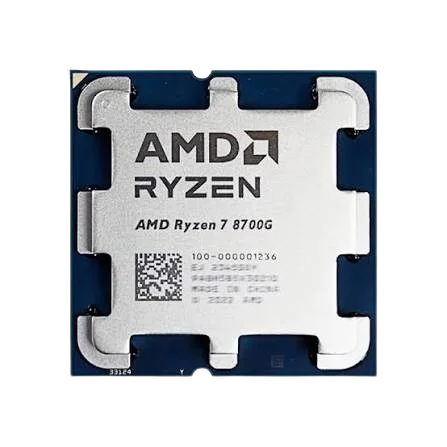
The Ryzen 7 8700G is AMD’s top desktop APU, a chip with a genuinely capable GPU built in, not a bare-minimum display-only iGPU. It’s part of the “Hawk Point” Ryzen 8000G family, built for one job: real gaming and productivity performance on AM5 without a separate graphics card.
What is The Release Date of 8700G?
AMD launched it on January 31, 2024, alongside the six-core Ryzen 5 8600G, as the flagship of the Ryzen 8000G “Hawk Point” lineup.
Price & Availability
Launch MSRP was $329. It now typically sells for around $260–$270, per Pangoly’s price-tracking data, a solid discount, though prices fluctuate with promotions.
What are The Specifications of Ryzen 7 8700G?
| Specification | Detail |
|---|---|
| Cores / Threads | 8 / 16 |
| Architecture | Zen 4 (“Hawk Point”) |
| Base Clock | 4.2 GHz |
| Max Boost Clock | 5.1 GHz |
| L2 Cache | 8 MB (1 MB per core) |
| L3 Cache | 16 MB |
| TDP | 65W (up to ~88W under boost) |
| Process Node | 4nm (TSMC) |
| Socket | AM5 |
| Integrated Graphics | Radeon 780M (RDNA 3, 12 CU / 768 stream processors, up to 2.9 GHz) |
| NPU (Ryzen AI) | Up to 16 TOPS (XDNA architecture) |
| Memory Support | DDR5, up to 256GB, officially up to DDR5-5200 |
| PCIe | PCIe 4.0, 20 lanes (16 usable for a discrete GPU) |
| Multiplier | Unlocked (CPU and iGPU overclockable) |
| Included Cooler | AMD Wraith Spire |
| Launch Price / Date | $329 MSRP, January 31, 2024 |
Verified against AMD’s official product page, TechPowerUp, and Notebookcheck.
What Generation is Ryzen 7 8700G?
It uses AMD’s Zen 4 CPU architecture (the same core design as mainstream Ryzen 7000-series chips) on a 4nm TSMC process.
Its Radeon 780M graphics use RDNA 3, the same IP found in Radeon RX 7000-series discrete cards, scaled to 12 compute units, plus a first-generation XDNA NPU for on-chip AI acceleration.
What Platform Does Ryzen 8700G Support?
It runs on AMD’s AM5 socket, so it’s DDR5-only and needs a B650 or X670-series board. Since the 8700G leans on its iGPU rather than raw lane count, most builders don’t need the extra PCIe headroom an X670 board provides, so a B650 is the smarter match here.
Performance Benchmarks
Here’s how the Ryzen 7 8700G performs in overall tasks.
Compression Benchmarks
In Hardware Busters‘ WinRAR and 7-Zip testing, the 8700G holds its own among Zen 4 peers, helped by its 16MB L3 cache. It doesn’t outpace higher-TDP Ryzen 7000 desktop chips in raw throughput. Its 65W ceiling, not the architecture, is the limiting factor.
AI Usage
The 8700G’s XDNA NPU delivers up to 16 TOPS, which is a first for a desktop chip. TechPowerUp found AI-assisted workloads respond noticeably to faster DDR5, much like the iGPU does.
Right now this is more future-proofing than daily necessity, since most AI software still leans on the GPU or cloud, but it’s a head start as Windows leans further into on-device AI.
Rendering
Cinebench R23 testing put the 8700G at roughly 1,500 single-core and 12,000 multi-core points on their bench, which is solid for an 8-core/16-thread chip and enough for light-to-moderate content creation. Scores shift with RAM timings and cooling, so treat any single figure as a ballpark.
Is The Ryzen 7 8700G Good for Gaming?
Yes, with a caveat: it’s genuinely good for 1080p gaming at medium-to-high settings in a real range of titles, using only its Radeon 780M graphics.
| Games (Med-High Settings) | FPS |
|---|---|
| ARC Raiders | ~70 |
| The Last of Us Part II Remastered | ~45 |
| Cyberpunk 2077 | ~45 |
| Red Dead Redemption 2 | ~45 |
| Battlefield 6 | ~70 |
Note: These come from the Ryzen 7 8700G’s own Radeon 780M graphics. No discrete GPU was used.
That lines up with what Tom’s Hardware and PC Gamer found at launch. The Radeon 780M was the first iGPU capable of legitimate 1080p gaming, competitive with entry-level cards like the GTX 1650.
Still, ~45 FPS in Cyberpunk 2077 or RDR2 is playable, not silky smooth. Lighter esports titles run noticeably better. Once you want more headroom, that’s where the AMD vs Nvidia decision for a discrete card starts to matter.
Source for these gaming benchmarks: Christo Gevedjov
What is The Main Use of 8700G?
The 8700G’s job is filling the gap between “no gaming PC” and “gaming PC with a $300+ graphics card”. It’s aimed at:
- Budget or first-time builders who want to play now and add a GPU later
- Compact HTPC and ITX builds where a discrete GPU is impractical
- Office/productivity systems that occasionally need light gaming or media playback
- Light content creation where a discrete GPU isn’t essential
It’s a different animal from CPU-only Ryzen 7 chips. Whether the Ryzen 7 lineup overall is “good” depends entirely on which model, a CPU-only chip like the Ryzen 7 5700X or the newer Ryzen 7 7700X.
The 8700G solves a different problem. For the broader decision framework, our how to Pick a CPU guide is a good next stop.
Ideal Build Example for 8700G
Because the 8700G’s iGPU performance scales directly with memory speed, the build around it matters more than usual:
| Component | Recommendation | Why It Fits |
|---|---|---|
| CPU | AMD Ryzen 7 8700G | 8 cores/16 threads plus Radeon 780M graphics |
| Motherboard | B650 chipset | Covers what this chip needs without paying for X670 features it won’t use |
| RAM | 32GB (2x16GB) DDR5-6000, CL30 | Faster RAM directly boosts iGPU frame rates |
| Storage | 1TB NVMe PCIe 4.0 SSD | The 8700G doesn’t support PCIe 5.0, so Gen4 is the practical ceiling |
| PSU | 550–650W 80+ Gold | Headroom now saves a second purchase later |
| Case | Compact mATX or ITX | Plays to the APU’s small-form-factor strength |
| CPU Cooler | Stock Wraith Spire (included) | More than sufficient for a 65W chip |
Who Should Buy This CPU?
Best for:
- Builders who want to game today without buying a GPU right away
- Small, quiet, low-power builds (HTPC, ITX, office rig)
- Light creators who want decent CPU performance without discrete-GPU cost
- AM4 upgraders coming from chips like the Ryzen 7 2700X or Ryzen 7 3700X, the jump brings DDR5, AM5, and a genuinely useful iGPU, not just a modest core bump;
Our Ryzen 5 2600X review covers that older AM4 generation in more depth.
Not the right fit for:
- Gamers chasing high-refresh AAA performance, which is a 9800X3D/9850X3D territory
- Anyone who already knows they’re buying a mid-range-or-better GPU soon (a Ryzen 5 7600X plus a card outperforms it for similar money)
- Builders needing PCIe 5.0 storage or high lane counts
Still deciding between Ryzen 5 and Ryzen 7 in general? Our is AMD Ryzen 5 good breakdown is worth reading first, since the right chip depends heavily on whether integrated graphics matter to your build.
Would I Recommend 8700G?
I recommend it for a specific buyer. The 8700G isn’t trying to be a high-end gaming CPU and shouldn’t be judged as one. What it does is genuinely playable 1080p gaming with zero discrete GPU; it does better than anything else on AM5, and that’s still true nearly three years on, with no confirmed Zen 5 successor shipped as of this writing.
My take: at its current street price, this is one of the easier “yes” calls in the budget-build space, specifically for people who need a working gaming PC now and a graphics card later.
Not for people who already want a discrete GPU from day one. Judge it by the job it’s built for, and it holds up well.
If maximum gaming performance with a discrete GPU is the actual goal, that’s a different conversation our Ryzen 9800X3D review and Ryzen 9850X3D cover that end of the lineup.
