

The 2700X is in an interesting spot in 2026. If it is already sitting in your AM4 system, replacing it might not be urgent, but if you are considering buying one because of its low used price, the decision gets harder.
I’d especially think twice before pairing it with a faster GPU, because the CPU can start holding back gaming performance.
So before spending money on this older 8-core chip, I’ll look at its gaming performance, benchmarks, compatible components, and the upgrades that make more sense today.
What is Ryzen 7 2700X?
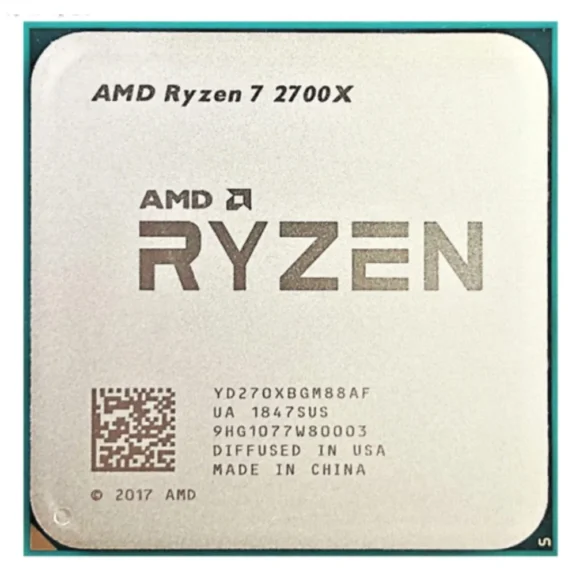
The Ryzen 7 2700X is AMD’s second-generation Ryzen 7 desktop processor. It’s an 8-core, 16-thread part built for gamers and multitaskers, and it’s the CPU that first made AMD look genuinely competitive with Intel again.
What Architecture Does it Have?
The 2700X runs on AMD’s Zen+ architecture, code-named “Pinnacle Ridge.” It’s a refinement of the original Zen design rather than a ground-up redesign built on a 12nm GlobalFoundries process that let AMD push clock speeds higher without raising voltage.
What Zen+ Actually Changed:
- 12nm process node (up from 14nm on first-gen Zen)
- Improved Precision Boost 2 algorithm for more consistent boost clocks
- Refined cache and memory-controller latency
- Roughly a 3% IPC uplift clock-for-clock over the original Zen, according to TechPowerUp’s architecture teardown
Best for: Multi-threaded workloads and moderate overclocking headroom.
Note: It’s still a refinement, not a redesign so don’t expect the generational leaps AMD’s later Zen 3/Zen 4 chips delivered.
What Gen is the Ryzen 7 2700x?
The Ryzen 7 2700X is a 2nd-generation Ryzen desktop CPU, part of the Ryzen 2000 series. It launched alongside the Ryzen 5 2600X and the standard Ryzen 5 2600, forming AMD’s second wave of Ryzen desktop chips.
When Did Ryzen 7 2700X Came Out?
AMD released the Ryzen 7 2700X on April 19, 2018. It was announced a few days earlier, on April 13, alongside the rest of the Ryzen 2000 lineup and AMD’s new X470 chipset.
What is The Price of 2700X?
At launch, the Ryzen 7 2700X carried a $329 MSRP (around £299). AMD no longer sells it new, so today it’s almost exclusively a used-market chip.
Based on current used-hardware pricing trackers, expect to pay roughly $50–$65 for a used unit in 2026.
What are the Specifications of Ryzen 7 2700X?
| Specification | AMD Ryzen 7 2700X |
|---|---|
| Cores / Threads | 8 / 16 |
| Base Clock | 3.7 GHz |
| Boost Clock | Up to 4.3 GHz |
| Architecture | Zen+ (“Pinnacle Ridge”) |
| Process Node | 12nm (GlobalFoundries) |
| L2 Cache | 4MB (8 x 512KB) |
| L3 Cache | 16MB |
| Socket | AM4 |
| TDP | 105W |
| Memory Support | Dual-channel DDR4-2933, up to 64GB |
| PCIe Lanes | 20 (16 for GPU + 4 for storage), PCIe 3.0 |
| Integrated Graphics | None |
| Included Cooler | Wraith Prism RGB LED |
| Multiplier | Unlocked (overclockable) |
What Components to Use With Ryzen 7 2700X?
The 2700X is flexible on AM4, but pairing it with the right motherboard, GPU, RAM, and PSU makes a real difference in how far it stretches in 2026. Here’s what actually makes sense for this chip.
Motherboard
The Ryzen 7 2700X uses AMD’s AM4 socket, and it’s compatible with everything from its original X470/B450 boards up through later B550 and X570 motherboards, provided the BIOS supports it.
If you’re piecing together a build or just trying to understand CPU-motherboard compatibility in general, our guide to picking a CPU walks through the basics.
Best For: Reusing an existing AM4 board rather than buying new.
Suggestion: Don’t buy a brand-new AM4 board specifically for this CPU, that money is better spent on a modern platform.
A real-world example I came across while researching: a Tom’s Hardware forum user running a 2700X on an ASRock B450M motherboard, paired with an RX 580, recently upgraded to 64 GB of DDR4-3200 RAM and picked up an RTX 3060 Ti, and was asking what the board’s actual CPU ceiling was.
That’s a pretty common situation for 2700X owners: the rest of the system quietly outgrows the CPU.
GPU
Because the 2700X’s single-core performance is dated, it’s best matched with a mid-range GPU rather than anything flagship-tier. An RTX 3060 or RTX 3060 Ti-class card keeps the CPU and GPU reasonably balanced at 1080p without one bottlenecking the other too badly.
Best For: RTX 3060 / 3060 Ti or equivalent AMD cards.
If you’re weighing AMD vs Nvidia for this kind of build, our AMD vs Nvidia comparison breaks down how each brand handles this price bracket.
RAM
Officially, the 2700X supports dual-channel DDR4-2933. In practice, Zen and Zen+ chips are sensitive to memory speed because of how AMD’s Infinity Fabric interconnect works, so many owners, including the forum user mentioned above run DDR4-3200 or 3600 for a small but real latency improvement.
Remember: Going faster than what your motherboard officially validates can introduce stability issues; check your board’s QVL list first.
PSU
The 2700X’s 105W TDP isn’t demanding on its own, but total system draw depends heavily on your GPU choice. A quality 550–650W 80+ Bronze or Gold unit covers most RTX 3060-class builds comfortably.
Best For: 550–650W for most pairings; step up to something like our Cougar 850W PSU pick if you’re planning to upgrade to a more power-hungry GPU like 3080, so wouldn’t have to worry replacing the PSU again.
Beware: Don’t cheap out on the PSU just because the CPU itself is inexpensive, a weak unit undermines the whole build.
Does Ryzen 7 2700X Still Perform Well?
Depends on the workload. In multi-threaded productivity tasks, the 2700X still does real work; in single-core-heavy modern games, it’s clearly showing its age against anything from the last few Ryzen generations.
Performance Benchmarks
On Geekbench Browser, user-submitted results for the Ryzen 7 2700X average around 1,272 single-core and 7,362 multi-core points on Geekbench 6 numbers that place it well behind current mid-range CPUs in single-thread work but are still respectable in multi-core.
PassMark’s CPU benchmark database ranks the 2700X 1,192nd out of over 6,000 tested CPUs for multi-threaded performance, and its own listing plainly notes it’s “no longer competitive with newer CPUs,” which tracks with what most independent testing shows in 2026.
GamersNexus revisited the 2700X and its non-X sibling in 2023 with a modern game and production suite, and I’m pulling several of their figures below since that’s the most detailed independent retest available for this chip.
In production workloads, the 2700 needed 27 minutes to render GamersNexus’s Blender test scene, with the 2700X finishing about 12% faster; in 7-Zip compression, the 2700X ran about 11% ahead of the standard 2700. Both numbers illustrate the modest but real gains the X-suffix clock speed bump provides.
For in-socket upgrades, GamersNexus’s pricing table pegged a used Ryzen 7 3700X at roughly $90–$100 and a Ryzen 5800X3D at around $320 at the time of testing. Both are viable if you’re not ready to leave AM4 yet.
AMD’s own official spec page for the Ryzen 7 2700X confirms the base architecture details referenced throughout this guide.
Is Ryzen 7 2700X Still Worth It For Gaming?
For competitive and older titles, mostly yes. For newer, CPU-heavy AAA games at high frame rates, the 2700X is increasingly the limiting factor, especially once you pair it with a GPU faster than an RTX 3060 Ti.
Gaming Benchmarks
Here’s how the 2700X compares against an RTX 3070 pairing across a few current titles at 1080p, based on our benchmark reference for this guide:
| Games (1080p) | RTX 3070 | R7 2700X | Avg. FPS |
|---|---|---|---|
| The Last of Us Part I | ~72% | ~80% | ~80 |
| God of War Ragnarök | ~39% | ~28% | ~85 |
| Cyberpunk 2077 | ~60% | ~65% | ~100 |
| Forza Horizon 5 | ~40% | ~50% | ~150 |
Separately, GamersNexus’s 2023 gaming retest found the 2700X running Baldur’s Gate 3 at 1080p/Medium roughly 10% ahead of the standard 2700, Cyberpunk 2077: Phantom Liberty at 1080p/Medium about 9.5% ahead, and Rainbow Six Siege at 1080p/Very High around 8.2% ahead. All modest, consistent uplifts from the X-suffix clock bump rather than anything dramatic.
Suitable for: 1080p esports titles and older AAA games with a mid-range GPU.
Source: These gaming benchmarks are derived and studied from Benchmarked Hardware.
What I Think About Gaming on 2700X?
Honestly, I don’t think it’s worth building around for gaming in 2026. This is a 2018 chip, and both its generation and the aging parts of the AM4 platform struggle to keep pace with how demanding newer games have gotten on single-core performance.
If the FPS numbers in that table look decent to you, keep in mind that’s mostly the RTX 3070 doing the heavy lifting, not the CPU. Pair the 2700X with a genuinely modern GPU and you’ll start hitting a ceiling the card itself never would.
What Can Be The Main Use for 2700X?
Even with those gaming limits, there are a few scenarios where a 2700X you already own still earns its place in 2026:
- Budget or secondary gaming rig: paired with a modest GPU like an RX 580 or RTX 3060, it’s still fine for esports titles and older AAA games at 1080p.
- Streaming and light multitasking: with 8 cores and 16 threads, it has enough free threads to run OBS’s x264 software encoder alongside a game without tanking frame rates too badly.
- General productivity and homelab tasks: Plex transcoding, file compression, and lighter Blender or video-editing work still runs acceptably, per GamersNexus’s production benchmarks, even if slower than anything current.
Alternate CPUs to The Ryzen 7 2700x
If you’ve decided it’s time to move on, there are two realistic upgrade paths depending on whether you want to stay on AM4 or move to a new platform.
AMD Alternative:
Staying on AM4: A Ryzen 7 5700X is the closest thing to a drop-in upgrade. Same socket, same core/thread count, but built on the newer Zen 3 architecture with meaningfully better IPC. It typically sells in the $130–$200 range depending on the retailer and timing, and for most AM4 owners it’s a BIOS update away from working on their existing board.
Moving to AM5: The Ryzen 5 7600X is the better long-term pick if you’re willing to switch platforms. It’s genuinely faster than the 5700X on average across modern games, though it requires a new AM5 motherboard and DDR5 memory.
It’s also worth reading up on whether Ryzen 5 is still a good buy in general before committing to that tier.
If you want more headroom than either of those chips offers, it’s worth comparing the Ryzen 7 7700X against the newer Ryzen 7 9700X before deciding.
For a more all-in-one, GPU-light build, the Ryzen 7 8700G APU with its integrated Radeon 780M graphics is also worth a look, and I’ll be covering whether AMD’s Ryzen 7 lineup is a good bet across the board in a separate guide.
Intel Alternative
For the AM4-tier upgrade (matching the Ryzen 7 5700X), the Intel Core i5-12400F is the closest same-era competitor. Six cores/12 threads versus the 5700X’s eight cores/16 threads, but comparable gaming performance in most titles and typically a bit cheaper.
For the AM5-tier upgrade (matching the Ryzen 5 7600X), the Intel Core i5-13400F (or the newer Core i5-14400) is the natural rival. It trades some single- and multi-core benchmark performance for a lower price and the flexibility to still use DDR4 memory on an LGA1700 board, which can offset some of the AM5 platform cost.
What’s My Final Answer?
If you already own a Ryzen 7 2700X, I don’t think you need to panic-upgrade it. It’s still a fine chip for esports titles, older AAA games, and general multitasking, especially paired with a sensible mid-range GPU.
But if you’re shopping for a CPU from scratch in 2026, I wouldn’t recommend buying a 2700X, even at its current bargain-bin price. A Ryzen 7 5700X gets you meaningfully better performance for not much more money on the same AM4 socket, and if you’re open to a platform switch, the Ryzen 5 7600X gives you a longer runway on AM5.
The 2700X earned its reputation back in 2018, but in 2026, it’s best thought of as a “use it until it’s genuinely holding you back” chip, not a “go buy one” chip.
