
What if the difference between smooth gameplay and annoying stutters wasn’t your GPU—but your choice of memory?
Choosing between DDR4 vs DDR5 for gaming is one of the most important decisions when building or upgrading a gaming PC. Many gamers want to know whether newer DDR5 memory actually improves FPS, reduces stutters, or simply increases cost without real-world benefits.
The reality is that DDR5 offers higher bandwidth, faster speeds, and improved efficiency, but actual gaming gains depend heavily on your CPU, GPU, and the game itself. In many modern games, the difference is small to moderate, while DDR4 still performs strongly in well-balanced systems.
Understanding how system memory affects performance helps you choose the right setup for smooth and stable gaming in 2026.
How RAM Affects Gaming Performance?
System memory acts as a temporary workspace where the processor stores active game data. When a game loads textures, AI calculations, physics simulations, and world assets, it relies on RAM to deliver this information quickly to the CPU.
If the memory bandwidth is limited or the capacity is too small, the processor may need to wait longer for data access. This delay can result in stuttering, lower minimum frame rates, or inconsistent gameplay performance during demanding scenes.
Modern games heavily rely on high-speed data transfer because game worlds are larger and more complex than ever. Faster memory standards allow the processor to process larger data sets efficiently, especially in CPU-intensive games.
What is DDR4 Memory?
DDR4 stands for Double Data Rate Fourth Generation memory. By 2026, it’s been the dominant standard for over a decade (released 2014). It replaced DDR3 and introduced higher speeds, better efficiency, and larger module capacities.
Most gaming PCs using DDR4 operate between 3000 MHz and 3600 MHz. Over time, manufacturers refined the technology, reducing latency and improving stability. Because of this development, DDR4 remains extremely reliable for gaming systems.
Another reason DDR4 remains popular is affordability. The price of DDR4 kits is significantly lower than newer memory generations, making it attractive for budget gaming builds or upgrades to older PCs.
Advantages of DDR4 for Gaming
DDR4 continues to deliver strong performance across most modern games. When paired with a capable CPU and GPU, the difference compared with newer memory standards may be relatively small in many gaming scenarios.
Key advantages include:
- Lower upgrade costs
- Mature and stable technology
- Excellent performance for most games
Many competitive gamers still use optimized DDR4 memory with low latency timings. These kits can deliver very consistent performance, especially when combined with well-tuned CPU configurations.
Limitations of DDR4 Technology
Despite its reliability, DDR4 technology has limits compared with newer memory systems. The primary limitation is bandwidth, which affects how quickly data can move between the processor and system memory.
Modern CPUs continue becoming faster and more capable. As processors improve, memory bandwidth becomes increasingly important to avoid bottlenecks in data transfer. It’s only compatible with older motherboards. New boards (Intel 15th/16th Gen or AMD AM5/AM6) don’t support it at all.
Future CPU generations will likely focus entirely on newer memory standards, which means long-term platform support for DDR4 will gradually decline.
What is DDR5 Memory?
DDR5 represents the next generation of desktop memory technology. It was designed to handle the increasing data demands of modern processors, gaming engines, and multitasking tasks.
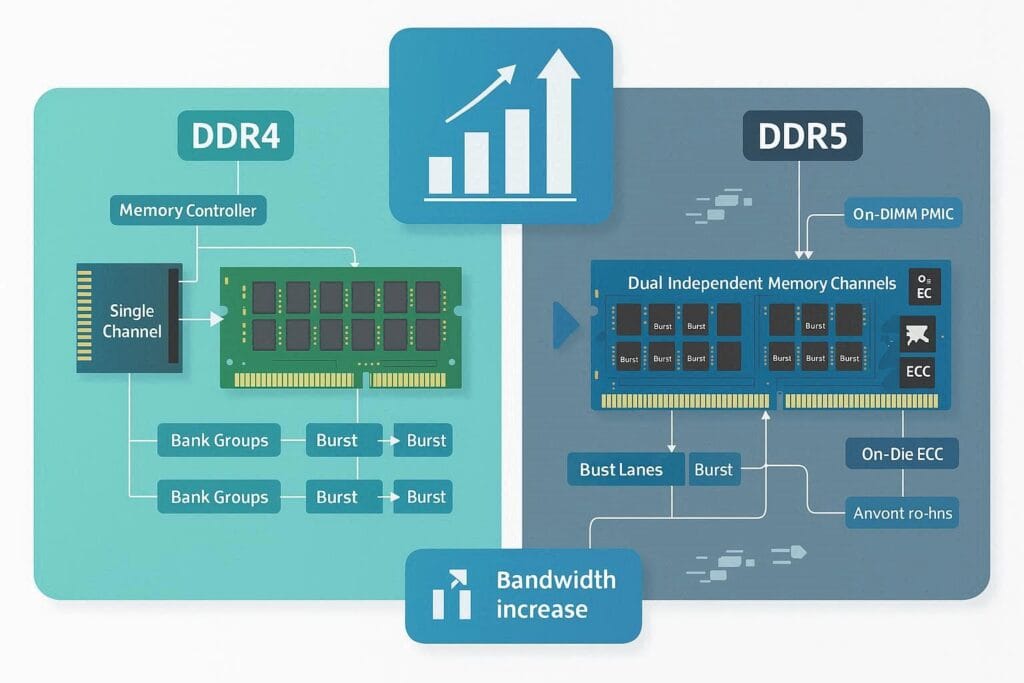
One of the biggest improvements is significantly higher memory bandwidth. DDR5 modules start at much higher base speeds than previous generations and can scale far beyond traditional DDR4 frequencies.
DDR5 also introduces architectural changes that improve efficiency. Each memory module contains two independent channels, allowing data to be processed more efficiently and reducing delays during heavy workloads.
Advantages of DDR5 for Modern Gaming Systems
The most noticeable improvement in DDR5 technology is the increase in memory speed. Faster speeds allow more data to move between RAM and the CPU every second.
Key benefits include:
- Higher bandwidth for modern processors
- Improved memory channel architecture
- Lower power consumption
- Greater capacity per memory module
These improvements can help newer processors perform more efficiently, especially when handling complex game simulations or multitasking tasks like streaming and recording gameplay.
What is the Real Gaming Difference Between DDR4 and DDR5?
In real-world gaming tests, the difference between the two memory generations is often smaller than expected. Graphics cards typically determine overall gaming performance more than system memory.
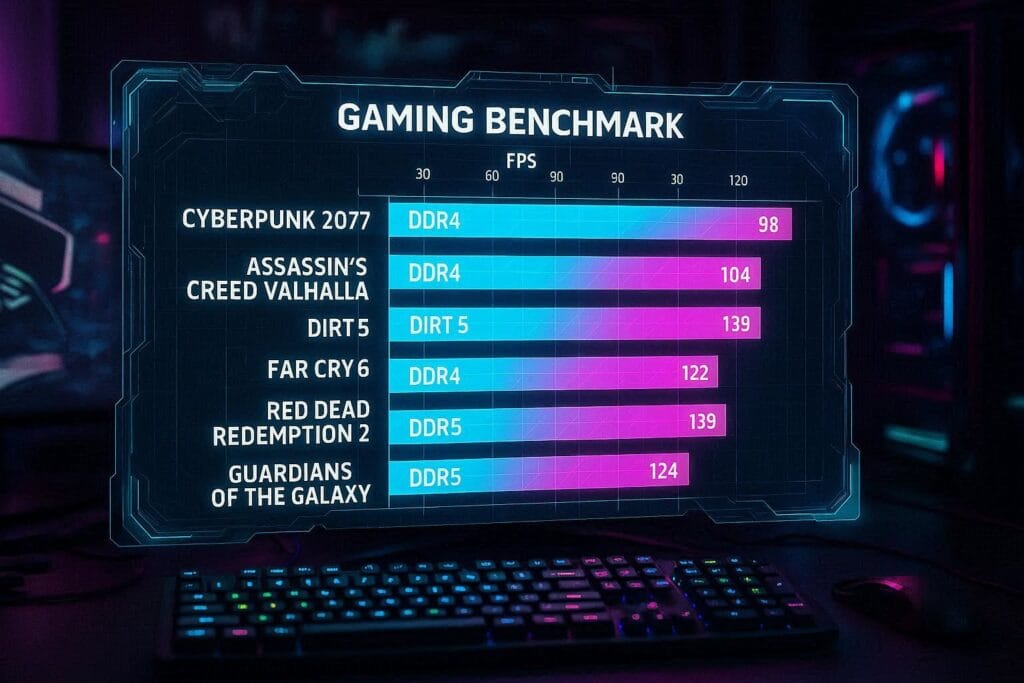
In many games, average FPS differences remain relatively small. However, faster memory can improve minimum frame rates and reduce minor stutters, which may result in smoother gameplay overall.
Competitive esports games sometimes benefit more from higher memory bandwidth because they rely heavily on CPU performance. In those cases, faster RAM can help improve frame consistency.
Games That Benefit Most From Faster RAM
Particular kinds of games rely more heavily on CPU calculations and system memory performance. These titles are more likely to benefit from faster memory speeds.
Examples include:
- Real-time strategy games (e.g., Broken Arrow)
- Large open-world simulation games (e.g., Microsoft Flight Simulator)
- Competitive esports titles (CS-2 and Valorant)
- Physics-heavy sandbox games (e.g., Teardown or BeamNG.drive)
These types of games constantly process large amounts of data, making memory bandwidth more relevant to gameplay performance.
RAM Speed vs Latency Explained
Many gamers focus only on RAM speed when choosing memory kits, but latency is another important factor. Latency refers to how quickly the memory responds to a request from the processor.
Higher frequency memory transfers data faster, but higher speeds often increase latency values. The ideal gaming memory configuration balances both speed and timing for optimal performance.
For example, well-optimized DDR4 kits with low latency can sometimes perform similarly to entry-level DDR5 kits. This is why benchmark comparisons occasionally show small differences between memory generations.
Compatibility and Hardware Requirements
One important factor when upgrading memory is platform compatibility. DDR4 and DDR5 use different physical designs and electrical standards, which means they cannot be used with each other.
Older gaming systems using previous-generation processors typically support only DDR4. Newer CPUs designed for modern platforms often support DDR5 memory instead.
Before upgrading memory, gamers must ensure their motherboard and processor support the chosen memory standard.
Hardware Needed for DDR5
To build a gaming system using DDR5 memory, you typically need:
- A compatible DDR5 motherboard
- A modern gaming processor supporting DDR5
- Updated BIOS support for high memory speeds
Because of these requirements, upgrading to DDR5 often involves building a new PC rather than simply replacing memory modules.
How Much Does Each RAM Cost in 2026?
In 2026, the ‘early adopter tax’ for DDR5 has vanished. While DDR4 remains the cheaper option for those maintaining older machines, the price-to-performance gap has closed significantly. For a new build, the cost of a DDR5 kit is now comparable to what high-performance DDR4 kits cost a few years ago. Choosing DDR4 today is strictly a budget-conscious move for secondary builds or reviving older platforms like AMD’s AM4 or Intel’s 12th Gen.
However, the price difference between DDR4 and DDR5 systems has become smaller. Many gamers choose newer memory standards to ensure long-term compatibility with future hardware.
How Much RAM Do Gamers Need Today?
Capacity plays a major role in gaming performance. As modern games grow larger and more complex, memory requirements continue increasing.
Most gaming systems perform best with at least 16GB of RAM. This amount provides enough memory for modern games, background applications, and operating system processes.
Common gaming configurations include:
- 16GB for standard gaming setups (for entry-level)
- 32GB for streaming and multitasking
- 64GB for advanced workloads and content creation
Higher memory capacity can also improve multitasking performance when recording gameplay or running additional software while gaming.
What is the Future of Gaming Memory?
Gaming hardware continues evolving rapidly as developers push the limits of visual realism and world complexity. Faster memory technologies will play a larger role in supporting these advanced game engines.
As processors gain more cores and higher processing power, memory bandwidth becomes increasingly important to prevent system bottlenecks. Future gaming systems will rely more heavily on high-speed memory standards.
Over time, newer technologies will replace older memory standards completely. This cycle has occurred with every previous generation of computer hardware.
What to Actually Choose Between DDR4 and DDR5 for Gaming?
When comparing DDR4 vs DDR5 for gaming, the best choice depends on your current system, budget, and future upgrade plans. Both memory standards can deliver excellent gaming performance, but they serve slightly different needs. DDR4 remains a reliable and affordable option for gamers using older platforms, while DDR5 offers higher bandwidth and better support for modern CPUs and next-generation gaming systems.
If you’re deciding between the two, consider the following factors before upgrading your gaming PC:
- Choose DDR4 if you already have a compatible motherboard and want a budget-friendly upgrade.
- Choose DDR5 if you are building a new gaming PC and want better long-term performance.
- DDR5 provides higher memory speeds, which can improve performance in CPU-heavy games.
- DDR4 still delivers strong FPS performance in most modern games when paired with a powerful GPU.
- Platform compatibility matters, because DDR4 and DDR5 require different motherboards.
For most gamers in 2026, the decision comes down to whether you are upgrading an existing system or building a new one. If your current PC already runs DDR4 smoothly, upgrading only the memory may not provide a large performance boost. However, new gaming builds often benefit from the improved bandwidth and future-ready architecture of DDR5.
Gamer Should Also Know
RAM speed can affect frame rates in CPU-heavy games, but the impact is usually smaller than upgrading a graphics card. Faster memory can improve frame consistency and reduce stutters.
DDR5 offers higher bandwidth and faster speeds, which can help modern processors perform more efficiently. However, the difference in gaming performance may vary depending on the system configuration.
If you already have a powerful gaming PC using DDR4, upgrading only memory may not provide significant performance improvements. However, new gaming PC builds benefit from choosing DDR5 platforms.
By 2026, 32GB is rapidly becoming the recommended standard for AAA and modern gaming. 16GB is more of a “budget entry” level.
Storage devices such as SSDs have the biggest impact on load times. RAM can help with asset streaming during gameplay but has less effect on loading screens.
