
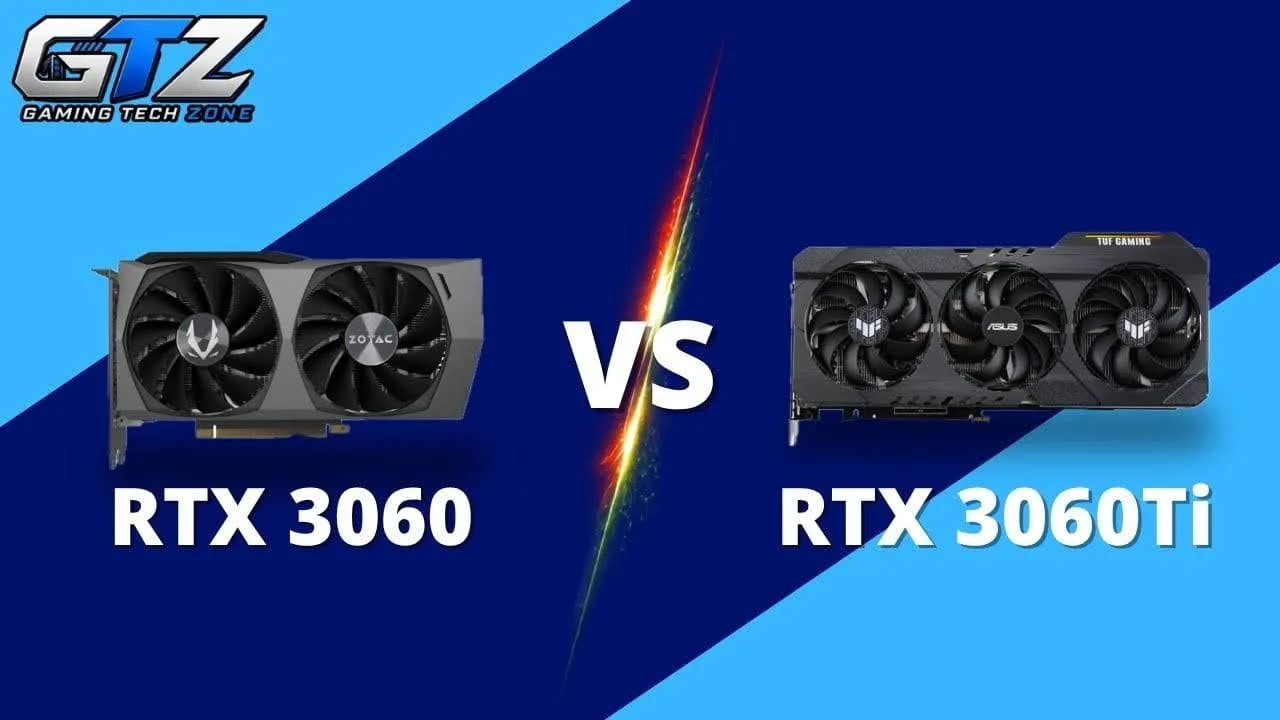
If you’re comparing the RTX 3060 vs 3060 Ti for a build in 2026, you’re not alone with GPU prices climbing across the board this year, these two Ampere-era cards have quietly become two of the smartest budget picks left standing.
We put both on the same test bench, ran the same games, and logged the same metrics so you don’t have to guess.
In this guide, you’ll get the real spec differences, side-by-side 1080p and 1440p benchmarks in current titles like Black Myth: Wukong and Dune: Awakening, and a straight answer on which one deserves your money.
Key Features
- Shared foundation: Both cards use Nvidia’s Ampere architecture on Samsung’s 8nm process, with real-time ray tracing and DLSS (2 and 3) support built in
- RTX 3060: 3,584 CUDA cores, available in 8GB or 12GB GDDR6, 170W TDP tuned for 1080p and light 1440p gaming, plus VRAM-heavy titles on the 12GB variant
- RTX 3060 Ti: 4,864 CUDA cores, 8GB GDDR6 on a 256-bit bus, 200W TDP built for higher-FPS 1080p and genuinely playable 1440p gaming
- DLSS Frame Generation: Both cards can run it via driver update, though through software fallback rather than dedicated hardware, unlike Nvidia’s 40- and 50-series cards
- Everyday use cases: Esports and AAA gaming at 1080p/1440p, plus light content-creation work like video editing and 3D rendering
What is the Difference Between 3060 and 3060 Ti?
The RTX 3060 and RTX 3060 Ti sit one tier apart in Nvidia’s Ampere lineup, and that tier gap shows up in the silicon, the memory setup, and the price tag. Here’s what actually separates them, starting with that “Ti” label people often misread.
What Does ‘Ti’ Mean?
“Ti” stands for Titanium, a suffix Nvidia has used since the GeForce 4 Ti era to mark a higher-binned, faster version of a base GPU. On the RTX 30-series, the 3060 Ti isn’t just a factory-overclocked 3060. It’s built on a different, more capable die entirely, which is why the performance gap runs deeper than the name alone suggests.
What This Means in Practice?
Buyers who assumed “Ti” meant a minor bump. No, it’s more than that here. The Ti naming doesn’t tell you anything about VRAM, which actually goes down on the Ti compared to the 12GB 3060.
Once you know the pattern, it’s easy to read across Nvidia’s lineup, our 3080 vs 3080 Ti breakdown shows the same naming logic playing out a tier up.
Main Architectural Difference
Both cards share the same Ampere architecture and 8nm Samsung process, but the RTX 3060 Ti runs on Nvidia’s GA104 die with 4,864 CUDA cores, while the RTX 3060 uses the smaller GA106 die with 3,584 CUDA cores, which is about 36% more shader cores on the Ti, plus a meaningful bump in RT and Tensor cores for ray tracing and DLSS.
| Spec | RTX 3060 | RTX 3060 Ti |
|---|---|---|
| GPU Die | GA106 | GA104 |
| CUDA Cores | 3,584 | 4,864 |
| RT Cores | 28 | 38 |
| Tensor Cores | 112 | 152 |
| Boost Clock | ~1,777 MHz | ~1,665 MHz |
| Memory Bus | 128-bit (8GB) / 192-bit (12GB) | 256-bit |
| TDP | 170W | 200W |
Where the VRAM Trade-Off Comes In
- The 3060 12GB if you play VRAM-heavy or texture-modded games at high settings
- Note: More VRAM doesn’t automatically mean more FPS. The Ti’s extra cores usually still win outright
What is the Price Difference Between 3060 and 3060 TI?
Both cards launched years ago at $329 (3060) and $399 (3060 Ti), but 2026 pricing doesn’t look like that anymore. An industry-wide GDDR/DRAM memory shortage, driven largely by AI data center demand, has pushed new-GPU pricing above MSRP across much of the market, even on cards this old. While used and open-box listings have stayed comparatively closer to historical norms.
Source: RTX 30 series 2026 market cap.
| Variant | Original MSRP | Typical Used Price (2026) | Typical New/Retail Price (2026) |
|---|---|---|---|
| RTX 3060 8GB | $329 | ~$150–$250 | Limited new stock |
| RTX 3060 12GB | $329 | ~$200–$280 | ~$350–$480 |
| RTX 3060 Ti 8GB | $399 | ~$200–$320 | ~$350–$650+ |
Budget Reality Check
- Best For: Buyers who check used marketplaces (eBay, r/hardwareswap, local listings) before new retail
- Important: New-card prices on either GPU can swing widely week to week right now because of the ongoing memory shortage. Don’t anchor to one price you saw once
- Even at inflated 2026 prices, both cards remain far cheaper than most current-generation budget options
What is the Performance Difference Between the RTX 3060 vs 3060Ti?
Specs only tell half the story, so we put both cards through the same test bench across four current-generation titles at 1080p and three at 1440p. Here’s exactly what we saw. FPS, GPU load, and temperatures included.
Basic Gaming Benchmarks (1080p)
Specs used for testing:
- CPU: Ryzen 9 7900X (Single CCD)
- Motherboard: MSI PRO X670-P WIFI
- RAM: 2x16GB DDR5-6200 CL30
- Cooler: MSI Coreliquid S360
- Storage: Samsung 980 Pro 1TB + 2x WD Blue SN570 2TB
- PSU: Corsair RM1000X
- OS: Windows 11 Pro 24H2.
All games below were tested at 1080p settings. If you’re building specifically around this resolution, our 1080p gaming PC guide can help you round out the rest of the parts list.
Black Myth: Wukong
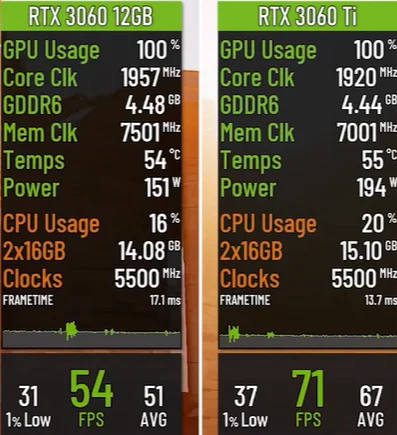
| Benchmarks | RTX 3060 | RTX 3060 Ti |
|---|---|---|
| GPU Usage | ~99% | 99% |
| Temp | ~70°C | ~60°C |
| Avg FPS | 60 | ~70 |
GTA V (Enhanced)
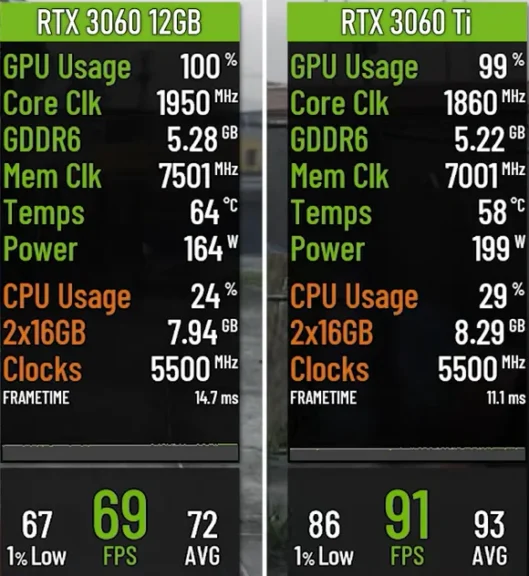
| Benchmarks | RTX 3060 | RTX 3060 Ti |
|---|---|---|
| GPU Usage | 100% | 99% |
| Temp | ~65°C | ~60°C |
| Avg FPS | ~70 | ~90 |
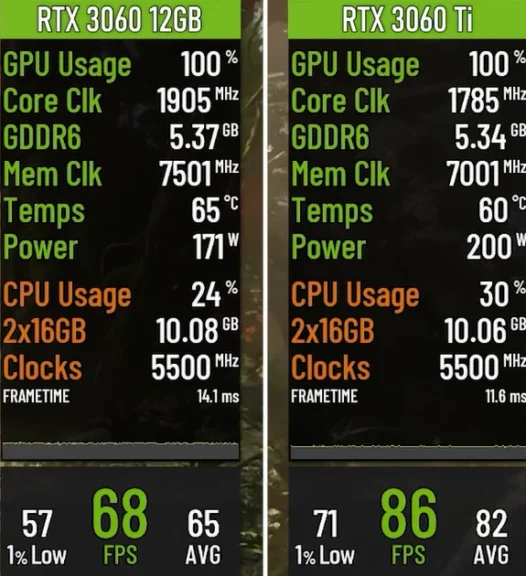
God of War Ragnarök
| Benchmarks | RTX 3060 | RTX 3060 Ti |
|---|---|---|
| GPU Usage | 100% | 100% |
| Temp | ~65°C | 60°C |
| Avg FPS | ~70 | ~90 |
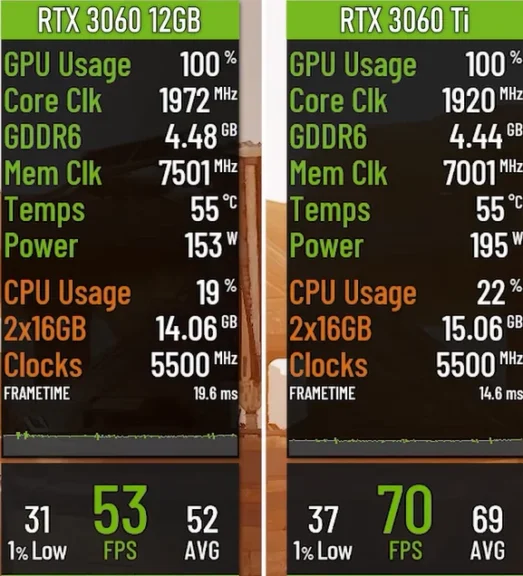
Dune: Awakening
| Benchmarks | RTX 3060 | RTX 3060 Ti |
|---|---|---|
| GPU Usage | 100% | 100% |
| Temp | ~60°C | ~60°C |
| Avg FPS | ~50 | ~70 |
1440p Gaming Benchmarks
Same test rig as above, same three titles carried over to see how the gap changes at a higher resolution.
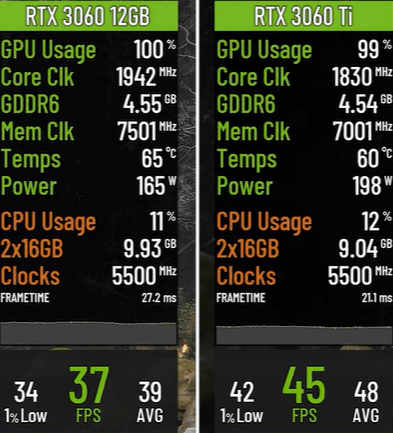
Black Myth: Wukong
| Benchmarks | RTX 3060 | RTX 3060 Ti |
|---|---|---|
| GPU Usage | 100% | 100% |
| Temp | ~66°C | ~60°C |
| Avg FPS | ~40 | ~50 |
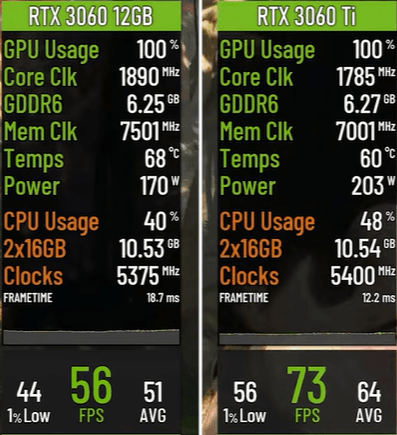
God of War Ragnarök
| Benchmarks | RTX 3060 | RTX 3060 Ti |
|---|---|---|
| GPU Usage | 100% | 100% |
| Temp | ~68°C | 60°C |
| Avg FPS | ~55 | ~70 |
Dune: Awakening
| Benchmarks | RTX 3060 | RTX 3060 Ti |
|---|---|---|
| GPU Usage | 100% | 100% |
| Temp | ~60°C | ~61°C |
| Avg FPS | ~35 | ~40 |
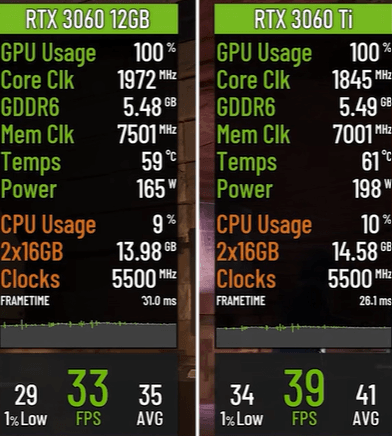
Source: All of these benchmarks are derived and studied from NJ Tech’s YouTube channel.
If you want a card that gives excellent performance on 2k and 4k, it is worth reading RTX 3080 vs 4080.
Final Comparison of 3060 vs 3060 Ti
| Category | RTX 3060 | RTX 3060 Ti |
|---|---|---|
| Architecture | Ampere | Ampere |
| CUDA Cores | 3,584 | 4,864 |
| VRAM | 8GB or 12GB GDDR6 | 8GB GDDR6 |
| Memory Bus | 128-bit / 192-bit | 256-bit |
| TDP | 170W | 200W |
| Avg 1080p FPS (our tests) | ~60 | ~78 |
| Avg 1440p FPS (our tests) | ~43 | ~53 |
| Launch MSRP | $329 | $399 |
| Best For | 1080p budget builds, VRAM-heavy titles (12GB) | Higher-FPS 1080p, playable 1440p |
Pros and Cons
| Model | Pros | Cons |
|---|---|---|
| RTX 3060 (8GB/12GB) | Lower price, solid 1080p performance, 12GB variant handles VRAM-heavy textures well | Fewer CUDA cores, weaker ray tracing, narrower memory bus |
| RTX 3060 Ti | ~20–30% faster across our tests, stronger RT/Tensor core count, real 1440p headroom | Higher TDP, only 8GB VRAM, pricier on the used market |
Would We Recommend the RTX 3060 Series in 2026?
We’d recommend the RTX 3060 series in 2026 if your main goal is smooth 1080p gaming or a mid-to-high settings mix. Either the 8GB or 12GB version gets that job done without paying for headroom you won’t use.
If your budget has a little more room, though, go with the Ti. Across every benchmark we studied, it landed 20–30% ahead of the standard 3060, and that gap only widens at 1440p or with ray tracing switched on.
Keep 2026’s memory-driven pricing in mind either way. New listings on both cards have been volatile, so used and open-box deals are usually your best entry point.
Either card is a genuinely solid, no-nonsense pick for budget 1080p or 1440p gaming right now. You’re not settling by choosing one over the other.If you want a card that give excellent performance on 2k and 4k, it is worth reading 3080 vs 4080.
If you’re also weighing AMD’s Radeon lineup against these two, our AMD vs Nvidia comparison breaks down how the competition stacks up, and if you’re building a full system around whichever card you land on, our guide to choosing PC parts walks through the rest of the parts list.
Gamers Also Ask About RTX 3060 Series
Yes, if your budget allows it. It was consistently 20–30% faster in our testing and handles ray tracing and 1440p noticeably better, even though it gives up some VRAM.
For 1080p and most 1440p gaming, yes, the 8GB still handles the majority of current titles fine, though a few VRAM-heavy games favor the RTX 3060 12GB instead.
Both can, but expect to lean on DLSS and lower RT presets, especially on the standard 3060, to keep frame rates comfortable, as our Black Myth: Wukong results show.
Partly its higher original MSRP, and partly 2026’s broader GDDR/DRAM memory shortage, which has pushed new-GPU pricing above MSRP across the market.
The RTX 3060 Ti, clearly. It held a meaningful FPS lead over the 3060 in every 1440p test we ran, especially in newer, more demanding titles like Dune: Awakening.
